Optical Illusion Art
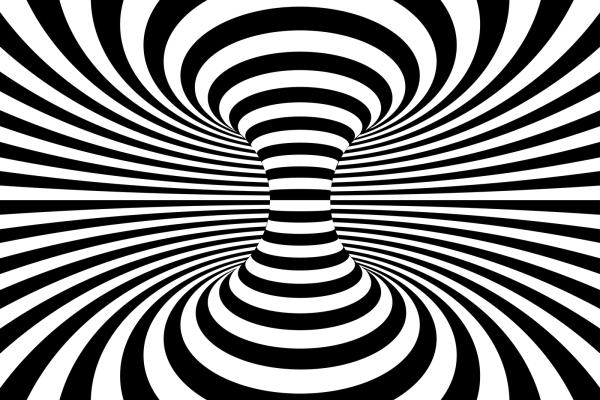
Optical illusions are popular and world renown. They come in various shapes, sizes, styles, appearances and colours. Each illusion is widely different yet commonly linked due to the feelings of displeasure and nausea they create when one perceives them. Illusions can vary as some shape-shift or appear to be moving. This is created due to the what the eye believes it is seeing. The eye believes the image is moving which confuses the brain as it we know the image itself isn't moving. Due to this it creates feelings of irritation and provoke queasiness. Depending on the person, some like the effect illusions have whereas others do not. As it has been described, illusions are a perception that is obscured from reality. "Focusing isn’t just an optical activity, it is also a mental one." - Bridget Riley.
Illusions can date back to the 5th century B.C when Epicharmus fist presented the explanation of this phenomenon. He believed that our minds know and understands everything, and that the blame is heavily applied on the sensory organs as they deceive us. In contradiction, another Greek philosopher, Protagoras, believed that it was the environment that deceived us not our sensory organs. These potential theories have added to the confusion illusions created today. Towards the 60's, the popularity of illusions rose among abstract painters in a movement titled 'Op Art'. Paintings were classed as Op Art if they included the following characteristic: hidden images, vibration, flashing and other patterns with a sense of misdirection. Artists like Bridget Riley, Vasarely and Kenneth Noland were just a few artists that explored and defined Op Art. "I am always wandering around in enigmas. There are young people who constantly come to tell me: you, too, are making Op Art. I haven't the slightest idea what that is, Op Art. I've been doing this work for thirty years now."
Illusions can date back to the 5th century B.C when Epicharmus fist presented the explanation of this phenomenon. He believed that our minds know and understands everything, and that the blame is heavily applied on the sensory organs as they deceive us. In contradiction, another Greek philosopher, Protagoras, believed that it was the environment that deceived us not our sensory organs. These potential theories have added to the confusion illusions created today. Towards the 60's, the popularity of illusions rose among abstract painters in a movement titled 'Op Art'. Paintings were classed as Op Art if they included the following characteristic: hidden images, vibration, flashing and other patterns with a sense of misdirection. Artists like Bridget Riley, Vasarely and Kenneth Noland were just a few artists that explored and defined Op Art. "I am always wandering around in enigmas. There are young people who constantly come to tell me: you, too, are making Op Art. I haven't the slightest idea what that is, Op Art. I've been doing this work for thirty years now."
In addition, illusions can lead ourselves to believe that something, for example a dot, can disappear and reappear as the eye focus on various sections of the image. A prime example for this is 'The Herman Grid'. When viewing this piece it is clear that there are fading dots. These 'dots' appear to be shifting from grey to white and vise versa. Like many optical illusions, theories have been proposed however scientists are yet to discover why. This illusion plays with my head therefore i am not the biggest fan of this one. There are multiple remakes of this version with bigger 'dots' and on a grander scale too.
:max_bytes(150000):strip_icc():format(webp)/376803788_9a771d0fdf_o-56a792513df78cf772973e4c.jpg) |
| Rob Patrick Robpatrick/ Flickr CC |
However, other illusions can trick our mind to believe a certain object or thing is spinning in a certain direction. For example 'The Spinning Dancer'. This certain illusion was supposedly a test to determine if you were either 'left-brained' or 'right-brained'. This has been proven false as with enough persuasion and concentration you can see the dancer circle either direction. This illusion exists because our brain is trying to construct space around the dancer to help comprehend which direction she is spinning in. I particularly like this illusion as it allows me to essentially control what i see for a period of time. As concentrating on this image you can persuade yourself to reverse the direction of the dancer. I believe this is amazing yet scary.

Another popular illusion is the 'Negative Photo Illusion'. This particular illusion takes a negative photo of a woman and place three dots below her eye. As prompted, the viewer proceeds to stare at the dots for a minimum of 30 seconds (to achieve a desirable effect). After the allotted time is up, the viewer then proceeds to blink rapidly at a blank wall or brighter surface. To astonishment, the image now appears to be in full colour. This is due to your brain and your visual system effectively taking that negative image and converting it into a full colour image. I believe this type of illusion can be fun as it can replicated and used with various objects, animals, family and friends. Moreover it is easy to create one yourself.
 |
| Image by geloo, modified by Kendra Cherry |
Quotes from:
https://www.tate.org.uk/art
https://www.tate.org.uk/art


No comments:
Post a Comment