Wednesday, February 27, 2019

Optical Illusions

Optical Illusions Created By Me


When first researching Op Art, I was exploring what made Op Art and why it is so popular/recognizable. After searching on various platforms (Google/Pinterest), characteristics such as mono-tonal, geometric, moving, blurry, elongated are all commonly seen ideas throughout different illusions made by multiple artists. When creating my optical illusions, I kept these characteristics in mind to help me create these illusions. During the Op Art movement characteristics such as geometric, mono-tonal, moving were the most commonly seen throughout. This was due to there being a lack of technology therefore the artists were somewhat limited in what they could create. This means that most artists hand painted their illusions which took time and precision. However today, with the help of technology, we can created animated, colourful, quick illusions. Helpful applications such as Photoshop and Illustrator allow us to create illusions today and experiment with them more. 

These characteristics influenced me when creating my illusions. I decided to maintain a mono-tonal approach to directly link to the movement. This created geometric designs that move, change and link to the movement. However I began to experiment with different colours and tools within illustrator which gave me different effects. This began to make my illusions more contemporary as I started using colours, layers and tools that were not available to the artists in the movement. 
When looking through the various browsers and websites, I had to find different pieces of information. Firstly, I had to find how each piece was made. This would allow me to analyse how precise and defined each image was. In addition it would allow me to figure out if it was contemporary or historical as the process would have been different but similar. As well as the process, I needed to find the artists that created each piece. This would allow me to delve into detail and find more examples of their work inspiring me with new ideas. 
During the process of creating these illusions, I had the option to change the original shape of the illusion. Changing the shape did not reveal an immediate variation of the illusions but when furthering the process it became apparent. I chose a variety of shapes such as stars, circles, squares, rectangles and triangles. I decided to have a range of shapes to experiment with as it allow me to try the same technique on different shapes and how that effected the illusions. I chose to do this as in the 1960's artists such a Bridget Riley experimented with geometrical shapes. Artists used shapes and lines to define their image which gives them their illusions. By thinning the lines, placing them closer together and thickening them; the artists were able to create illusions that moved, blurred and transitioned from the background to the foreground. Also within each piece the colours are bold and striking which is a common featured. I replicated this within my work as it is a defining feature of Op Art. Lines are also repeated within each piece. This is how the illusion exists. Without the original lines the illusion cannot be.
After creating and experimenting with various illusions, I am going to apply these to a photo-shoot. I am going to be using objects and live models to project and paint my illusions onto each thing. This will create different effects as one will be computerized whereas the other hand painted. This will create a contrasting piece when comparing them at the end of the movement. Moreover I will be painting each object white as this will make each illusion more striking. Also I will dress the model in white to also achieve this effect. Another idea I have is to have multiple projects on various objects. For example, having multiple boxes of different sizes lined up and painted different colours. Then I will project different illusions on different boxes. Overlapping them may make an interesting effect.          


Wednesday, February 13, 2019

Liverpool Trip Review


Liverpool

We went on a trip to Liverpool to visit the Tate museum that was holding an Op Art exhibition. This exhibition was called 'Op Art in Focus'. This museum was holding the exhibition that was holding Bridget Riley's pieces as well as various other artists. We were focusing on Riley as her work reflected the Op Art movement and would be easy to reflect through a projector or hand painted on skin.

When first walking into the exhibit, it was clear this was an Op Art exhibition. The floor had a striking striped pattern which played tricks on your eyes. This wasn't apparent to me at first but as I moved round the exhibition I felt myself becoming lost within the flooring. Throughout this exhibit, the walls were painted white, adding more contrast from the paintings/sculptures. This made the exhibit harmonious and flow throughout the various rooms. In addition the multiple pieces of artwork were spaced differently throughout the room, making you explore and experience the exhibit. What surprised me was the diverse range of what artists claimed to be 'Op Art'. There was different materials, shapes, colours which all created an illusion. For example some used plastic, nails and electronics to give their desired effect. The wide range of ideas present by the different artists made me think about how i could approach this topic when creating my own piece. I viewed various pieces by Bridget Riley such as 'Untitled [Fragment 1/7] 1965' and 'Untitled [Fragment 5/8] 1965'. These are part of a series she created.

I enjoyed walking round the exhibition and viewing the different pieces. Each piece provided a different emotion when viewing them. Some provoked feelings of uneasiness while others provoked annoyance. Moreover, I enjoyed being able to view the different pieces from different angles that I couldn't previously on a monitor. I particularly enjoyed viewing [name]. This piece was captivating to me as even though the illusion was subtle it still created an impact. This piece incorporated mirrors suspended by nylon thread. With a combination of a light, it created the effect of the thread being missing in the shadow. Even though in person you can see the physical string, the shadow removed this element. To me, this was fascinating as something man made such as nylon thread can appear invisible under certain circumstances. Because of this I found myself repeatedly standing and staring at this piece. In addition, this piece incorporated motion without the need of a fan or electronics. This made the piece even more captivating as the piece moved on its down. Within the room there was no draft or movement other than people walking round the exhibition. This made the piece even more interesting as, along with the illusion from the shadows, this piece moved in a circular motion without nay encouragement.   

This exhibition enriched me in knowledge of the Op Art movement as snippets of information was posted about each artist and piece. This, along side being physically in front of the pieces, made me feel like I could experience the emotion and thoughts of those who viewed this when they were living in the movement. This made me feel that I could represent the movement with a contemporary twist as I have experienced this movement myself. Viewing this pieces on a monitor can become tiring and bore some as you don't achieve the full effect of the image. Being in front of the pieces made feel connected to each piece further rather then being viewed by millions form a screen of pixels.

Viewing these pieces first hand was so better than seeing it on a computer screen. When standing in-front of each image you could see the different materials used, techniques and he time it took to piece these together. In addition you can view each piece from various angles and distances, adding to the experience. When viewing it on a screen, you are limited to the resolution. Moreover you are limited to the chair and space around you as your computer has to remain plugged in. Whereas a physical painting can be moved to new rooms and spaces and place in different environments.            


Tuesday, February 5, 2019

Bridget Riley


Bridget Riley

Riley was born at Norwood, London, the daughter of a businessman. Her childhood was spent in Cornwall and Lincolnshire. From 1949 to 1952 she studied at Goldsmiths' College and also studied at the Royal College of Art from 1952 to 1955. Riley began painting figures in an semi-impressionist manner. However she changed to pointillism around 1958 which she mainly produced landscapes. She was immensely inspired by Georges Seurat who was a French pointillism artists. In 1960 she changed her style in which she explored the potentialities of Op Art. Riley's Op Art pieces such as 'Hesitate' 1964.
Hesitate, 1964.
These type of pieces create a disorienting physical effect on the eye. Riley taught children for two years before joining the Loughborough School Of Art. This is where she initiated a basic course on design in 1959. Riley taught at Hornsey School of Art and in 1962, at Croydon School of Art. At Hornsey, Riley began her first Op Art paintings. She worked only in black and white and used only simple geometric shapes such as squares, lines and ovals. Although she investigated many areas of perception, Riley's work emphasises on the optical effects. This wasn't based on theory but maths and movement that the eye believe it sees within an image. Whilst teaching at Croydon, Riley gained her first critical recognition, her own solo exhibition. The J. Walter Thompson Group, an advertising company, hired Riley from 1960. However, in 1963-4 she gave up teaching and working at the advertising company.
 She was awarded  the AICA Critics Prize in 1963 as well as won an Section Prize at John Moores' Liverpool Open. This was followed by an invitation to show her work in the prestigious "New Generation" exhibition at the Whitechaple Gallery alongside Allen Jones and David Hockney. Riley was awarded a Peter Stuyvesant Foundation Travel bursary to the USA in 1964. Moreover, she won an International Painting Prize at the Venice Biennale in 1968. "For me nature is not landscape, but the dynamism of visual forces." - Bridget Riley.

Her first solo exhibition was held at Gallery One with a second solo show within the following year, 1962. Also her work was held at other various locations such as Nottingham University, 1963; New York, 1966; British Pavilion, 1968.

Bridget Riley's paintings became international notice when she exhibited her work along side Victor Vasarely, the Founder of Op Art. The piece that was noticed was "The Responsive Eye", 1965. This was one of her pieces that was featured on the cover on the exhibition catalogue. "The Responsive Eye" was a huge hit with the public but proved to be less popular with the critics. These critics dismissed the work as 'trompe l'oeil' (trick of the eye). Despite the critics, Riley help another popular exhibition in New York. Tickets sold out on the first day. "It seems the deeper, truer personality of the artist only emerges in the making of decisions... in refusing and accepting, changing and revising." - Bridget Riley.  

Bridget's piece titled 'Hesitate' is one of her few Op Art pieces that have colour within them. Even though this is various shades of blues and blacks, this creates a distorted image that can be rotated to create different effects. This piece is entirely made up of dots. To create the illusion, Bridget used varying sizes of ovals changing the height of them, effectively squishing them, to give the illusion. Moreover by adding multiple shades of black and blue, it creates a gradient through the piece making the illusive effect on our eyes greater. This piece is relatively harmonious when removing the illusion from the picture. In addition, when rotated (I believe) the illusion becomes far more effective than in its original state. Each of her pieces draw you in, confusing you and intriguing you. Each time we view these illusions we try to convince ourselves that the image isn't moving or has a 3D element. But as we rely on our eyes as our main sense, they betray us causing a nauseous, uneasy feeling which we either love or hate. "In general, my paintings are multi-focal. You can't call it unfocused space, but not being fixed to a single focus is very much of our time." - Bridget Riley.

Quotes From:
https://www.tate.org.uk/art
https://www.brainyquote.com/
https://artsandculture.google.com/

Saturday, February 2, 2019

Op Art Research


Optical Illusion Art

Optical illusions are popular and world renown. They come in various shapes, sizes, styles, appearances and colours. Each illusion is widely different yet commonly linked due to the feelings of displeasure and nausea they create when one perceives them. Illusions can vary as some shape-shift or appear to be moving. This is created due to the what the eye believes it is seeing. The eye believes the image is moving which confuses the brain as it we know the image itself isn't moving. Due to this it creates feelings of irritation and provoke queasiness. Depending on the person, some like the effect illusions have whereas others do not. As it has been described, illusions are a perception that is obscured from reality. "Focusing isn’t just an optical activity, it is also a mental one." - Bridget Riley. 

Illusions can date back to the 5th century B.C when Epicharmus fist presented the explanation of this phenomenon. He believed that our minds know and understands everything, and that the blame is heavily applied on the sensory organs as they deceive us. In contradiction, another Greek philosopher, Protagoras, believed that it was the environment that deceived us not our sensory organs. These potential theories have added to the confusion illusions created today. Towards the 60's, the popularity of illusions rose among abstract painters in a movement titled 'Op Art'. Paintings were classed as Op Art if they included the following characteristic: hidden images, vibration, flashing and other patterns with a sense of misdirection. Artists like Bridget Riley, Vasarely and Kenneth Noland were just a few artists that explored and defined Op Art. "I am always wandering around in enigmas. There are young people who constantly come to tell me: you, too, are making Op Art. I haven't the slightest idea what that is, Op Art. I've been doing this work for thirty years now." - M.C. Escher

Op Art was a rising sensation after the Abstract Expressionism had ended. People enjoyed the physical response their bodies gave towards this type of art. However people opposed this art as it was obscuring the boarders on what 'art' could be classed as. With its geometrical mono-tonal style people were questioning why this was classed as art. Compared to the Pop Art movement, colour was limited, subject matter was removed leaving a relatively bare painting. People believed drawing lines on a page was not classed or art or should be perceived as art. Meanwhile others liked how the abstract way of developing lines to create physical effects. This movement created split opinions.

 In addition, illusions can lead ourselves to believe that something, for example a dot, can disappear and reappear as the eye focus on various sections of the image. A prime example for this is 'The Herman Grid'. When viewing this piece it is clear that there are fading dots. These 'dots' appear to be shifting from grey to white and vise versa. Like many optical illusions, theories have been proposed however scientists are yet to discover why. This illusion plays with my head therefore i am not the biggest fan of this one. There are multiple remakes of this version with bigger 'dots' and on a grander scale too. 

The Hermann Grid Illusion
Rob Patrick Robpatrick/ Flickr CC
 However, other illusions can trick our mind to believe a certain object or thing is spinning in a certain direction. For example 'The Spinning Dancer'. This certain illusion was supposedly a test to determine if you were either 'left-brained' or 'right-brained'. This has been proven false as with enough persuasion and concentration you can see the dancer circle either direction. This illusion exists because our brain is trying to construct space around the dancer to help comprehend which direction she is spinning in. I particularly like this illusion as it allows me to essentially control what i see for a period of time. As concentrating on this image you can persuade yourself to reverse the direction of the dancer. I believe this is amazing yet scary.


Another popular illusion is the 'Negative Photo Illusion'. This particular illusion takes a negative photo of a woman and place three dots below her eye. As prompted, the viewer proceeds to stare at the dots for a minimum of 30 seconds (to achieve a desirable effect). After the allotted time is up, the viewer then proceeds to blink rapidly at a blank wall or brighter surface. To astonishment, the image now appears to be in full colour. This is due to your brain and your visual system effectively taking that negative image and converting it into a full colour image. I believe this type of illusion can be fun as it can replicated and used with various objects, animals, family and friends. Moreover it is easy to create one yourself. 
Image by geloo, modified by Kendra Cherry

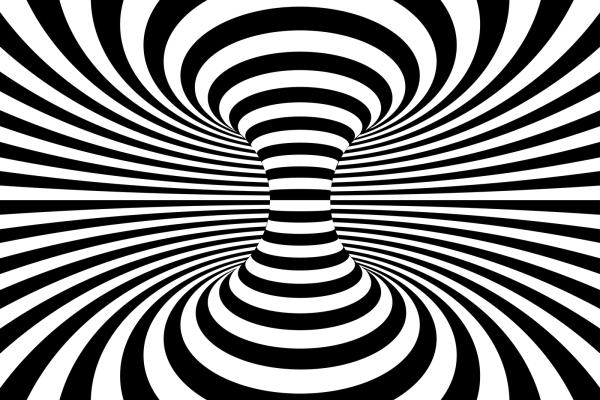
On the other hand, there are simple geometric illusions that are created with precision or with the assistance of Photoshop/other programs. These illusions generally consist of mono tone colours such as black and white. These illusions are the ones that create a sense of nausea and dread as they appear to be moving, vibrating, morphing and appear to draw you in. These pieces are commonly seen when one types 'illusions' into google. I believe these are the most common types of illusions as they are easily created. These illusions, like the one below, can also appear to be 3D. This dramatically effects what the eye sees as logically we know this is 2D.
Image result for optical illusions


Zine Evaluation

Final Evaluation Throughout my zine I have chosen to have variety within my zine. I choose to create interesting pages that captured t...